What high-performing teams need to succeed - and how leaders make it possible

Andy Hollingworth and Anna Britnor Guest
A conversation between an internal L&D expert coach and a leadership development specialist.
The provocation: what does your team actually need you for?
You want your team to be high-performing. You want them to work together, to act on their individual and collective initiative. You expect to be able to delegate and you trust them to do the right work. You’ve told them they are empowered.
Yet…
You're constantly getting pulled into the trenches or lurching from solving one problem to another. The strategic work slips down your ‘to do’ list each day. That’s a dynamic you have created. And it begs the questions: what value are you really bringing to your team – and how well are they actually performing?
Anna Britnor Guest and Andy Hollingworth debate some of the characteristics they've seen in teams that are overly dependent on the leader and what high-performing, collaborative teams do differently.
The TL:DR: the leader's role is critical as they create the environment in which the team operates.
The challenge for leaders

Andy: Fixing things feels good
As a leader, you've been conditioned to fix problems, to solve things, to keep things moving. You know the organisation, you know who to speak to and you can get things done. It feels good to fix things, there’s an endorphin hit. There’s also an enduring habit and belief that telling is quicker than coaching, particularly in a fast-moving operational environment.
The difficulty is what happens next. Every time there’s a problem, people learn that the leader will swoop in and fix it. Or they go straight to the leader because the leader will know what to do.
It becomes a perfect storm which perpetuates the cycle of dependency.
The leader needs to break it but simply saying, “You can fix this yourselves,” leaves a gap if the team hasn’t got a system or structure to operate without you. Which decisions can it make? What genuinely needs the leader's involvement? What work belongs to an individual or to the team collectively?

Anna: “I’ll speak up when it’s my domain”
There’s another tension here where that dependency shows up, and that’s in meetings. People arrive at a meeting as the person responsible for product, finance or revenue; their domain. It becomes a hub and spoke with the leader as chair and everyone speaking in turn about their area.
Let’s say I’m Head of Product and I’m in a meeting where we're talking about revenue. I leave that to the sales leaders. If we talk about finance, I'll leave that to the finance people. I don’t want to chip in with a question or an opinion about something that's not my domain, perhaps because I don't think I know enough or I don't think it’s my place to do it.
Being a good team player can become confused with leaving everybody else’s patch alone so we don’t accidentally throw someone under the bus with our question. We don’t see ways of constructively challenging or collaborating together across our tasks so we stick to our silos.
So you get what Andy describes as a “public one-to-one”. Everybody updates the leader while everybody else waits for their turn.
Meetings don’t feel very useful, valuable or purposeful. People spend an hour, but haven't got more than 5 minutes value out of it so it drops down the priority list.
Andy: “Everything else is urgent”
That’s another symptom of the leader stepping down and fixing everything. If that’s the culture, and team meetings don’t feel very useful, then when something more ‘urgent’ crops up, and we've got our team meeting this afternoon, I push it out because I prioritise the ‘urgent’ thing.
If people are really lurching from one urgent thing to the next urgent thing, it says a lot about the culture and the way they're operating, because most of those things are probably not urgent, really,
If there are 600 people in a function and eight of them can't come together for two hours every fortnight, what are the other 590 people doing? Surely they can cope without you?
The pattern spreads. If the senior leader is in the detail fixing everything, their team can mirror that with their own direct reports. Then something urgent comes up and their team meeting is the first thing to go.
Where we meet: create the conditions for successful team performance
Our shared view: The leader has work to do before stepping back. The team needs enough clarity of purpose and structure to act and the leader needs the discipline to let it.
What do high-performing teams do differently?
Anna:
I'm something of an F1 nut. A pit stop is completely dependent on every team member being absolutely on their mark at the right moment, acting in sync to get the car back out, fast. Just a 1 second delay could lose important points. There’s shared purpose, goal and measure of success, clear roles and everyone knows exactly how to work together with clear structure.
It reflects Squadify’s 3Cs which are our go-to benchmark for developing high performance in teams:
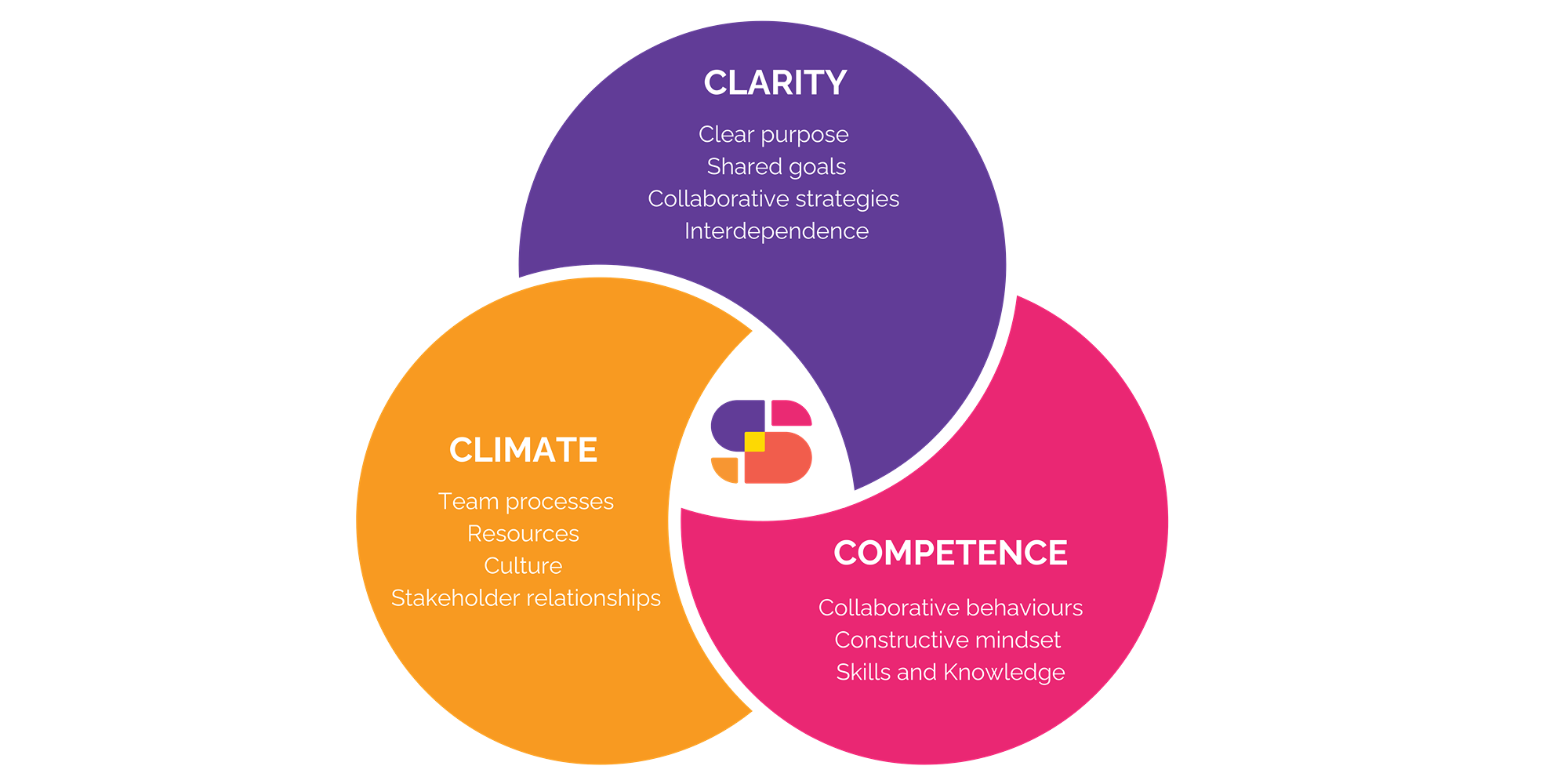
Clarity: including as in the example above, knowing your role and how to all work together.
Climate: clear structures, processes and a culture that supports the team to work effectively and efficiently.
Competence: a team that learns, coaches and supports - with the skills and knowledge to get the work done.
High-performing teams constantly assess their performance and working practices against these aspects.
Andy:
Lencioni’s five dysfunctions of a team are also a strong reference point for high performance. Teams that overcome the five dysfunctions develop the trust, ability to challenge constructively and collective commitment to share accountability and attention for achieving the results. Connecting the five dysfunctions to the 3Cs, Squadify talk about Clarity as the sixth dysfunction. If you don't have clarity as the foundation, the rest of the pyramid is built on unstable grounds.
Amy Edmondson’s psychological safety is another good underpinning area to focus on too. It doesn’t happen automatically just because the team is full of nice, well-meaning people. It takes work. The leader needs to start this process, but high-performing teams own it for their work together.
How to build high performance in your team
These are the conversations we would start with.
What is the leader’s priority?
If we think about Patrick Lencioni’s work on the ‘number one team’, the leader's most important team is their peers and their own line manager and what they should be doing up there, not getting dragged down into the detailed tasks in the team. That frees the leader up to do the strategic work they're supposed to do.
When leaders are pulled down into the detail, the first thing to go is their mental and time capacity to step back and think strategically and holistically about what they're doing as a business. Once they recognise that's where they truly need to spend more time, it creates a greater sense of urgency and purpose to step away from being the fixer within the team.
We’d encourage leaders to think about what they're really being asked to deliver to the business and where they should proactively spend their time.
But why should the team work together?
Often team members see themselves as a group of specialists all working in their own domains. That's what we'd call a TINO - a ‘team in name only’. To change this, start with the visible results and KPIs. What is their shared purpose that is better achieved by collaborating? What are the key shared measures of success, and how clearly defined are they?
Dan Hammond of Squadify describes the difference between telling people ‘we're going to the top of the hill’ and providing the actual coordinates that mark the top of the hill. One is far less open to interpretation or misunderstanding than the other. As an example, Andy worked with a team who had good intent to collaborate, but lacked clear purpose and structure. Meetings just didn't go anywhere and fizzled out. Then they identified specific practical initiatives they could work on without the leader, and that’s what made the difference.
Who does what when there’s no leader involved?
Teams are sometimes surprised by the idea that they could meet and work on shared challenges without the leader in the room. That realisation frees the leader to do the work they should be doing elsewhere and the team to act more autonomously. But first, the team needs to recognise that it has shared responsibilities.
Squadify data highlights how important it is for teams to have clear roles and to define how best to work together. It's worth spending time getting this in place. It's also important to have clear measures of success, so people really understand what achievement looks like. Make roles and connections clear. A ‘team on a page’ can help people to see where they depend on one another, where they can collaborate, and where they are independent workers.
Decide who has a voice and who has a vote.
This distinction helps open up the decision process when a group works together. Are you seeking consensus? Does one person have final say? Who needs to contribute before that happens?
We see indecision as rife, and for many reasons: FOMU (fear of messing up), uncertainty about what authority the team actually has, lack of clarity about how to evaluate the options or lack of decision making structure and process. As a result, people look to someone else to decide. Acknowledge and define these things so there’s clarity around decision making and when the leader needs to be involved.
Then the team can and should hold itself accountable for making and executing on decisions.
And what if the leader needs to decide?
Delegation isn’t binary. Andy describes a scale from “do what I say”, through to “crack on and do it”.

Apply that conversation to the team’s actual priorities. Agree what needs approval, what needs consultation and what people can progress themselves. Match that to the skill and experience available.
Practice not stepping in.
When a question comes to you as a leader, try this response “Do you need me to fix that or can you do it?” and “Are you looking for an answer, approval or validation?”
Coach rather than tell. Be explicit about the level of autonomy the individual has and the support available, then give people room to use the authority you’ve agreed. Notice whether your own behaviour invites everything back to you.
Agree what really needs escalation, then learn from it. Genuine emergencies happen. Prepare for them. Agree responsibilities and escalation routes for predictable urgent situations. Afterwards, reflect together and capture what should inform the response next time.
Make meetings worthwhile
Move detailed individual updates into the appropriate one-to-ones, platforms or make them visible beforehand. Set a clear outcomes-focused agenda.
Use team time for shared goals and collective blockers. What needs to change? Who can help?
For meetings without the leader, agree who will coordinate, how the agenda is set and what everyone is committing to contribute.
Learn together
We talked about teams sticking in their silos in meetings. Shared goals and psychological safety enable team members to ask questions of each other in the right context and with the shared purpose in mind. That way they learn together, build psychological safety to constructively challenge and help shape better outcomes.
Teams also need time to reflect together. A team can be friendly and supportive without spending much time learning from what it does. If the same issue keeps coming back, what have they understood about it, and what will they change?
The closing question: what will you stop being needed for?
At your next team meeting, take one live challenge that keeps coming back to you as the leader but which the team can decide and execute on. Experiment to see where your team are: step out of the decision-making process and see what happens when the team has to work together without you. Then help them create the framework they need to operate without you.
Then ask yourself: if I step out, what important work can I now do – and what more can I enable for the team to perform without me?
Meet the authors
Anna Britnor Guest
With over 20 years of running Alate and 30 years in B2B tech, Anna builds the sales and leadership capability that closes the gap between ambitious growth targets and the people who have to deliver them. She is a Member of the Institute of Directors, Squadify Pro, PRISM Practitioner and a Founding Fellow of the Institute of Sales Professionals.
Andy Hollingworth
As an EMCC-certified professional coach, Andy partners with leaders who want the space to think, reflect and lead more authentically. With 20 years’ experience across travel, tech and professional services, he is passionate about helping people grow in their roles, navigate transitions and take ownership of their success. Known for his listening, empathy and innovative approach, Andy uses storytelling and thoughtful conversation to put people at ease and create the space for meaningful insight and positive change.
FAQs
What is Squadify
Squadify is the leading team performance platform, leveraging the three conditions of success for high-performing teams. Squadify enables teams to measure their performance as a team by importance and presence in order to work together to improve their team's conditions and outcomes. Alate is an accredited partner of Squadify, and Andy Hollingworth is an accredited Squadify practitioner. Learn more about how we use Squadify to increase team engagement and peformance.
What are Squadify's 3Cs?
Squadify's three Cs are the three conditions of success for high-performing teams:
Clarity: Is everyone clear on the goal, measures of success, roles, etc.?
Climate: both the hard structure and systems and the culture.
Competence: capability, learning, and feedback.
What are the five dysfunctions of a team?
The five dysfunctions of a team were defined by Patrick Lencioni, who outlined the behaviours and attributes of teams that do not operate effectively and are not well aligned.
The five dysfunctions are:
Absence of trust
Fear of conflict
Lack of commitment
Avoidance of accountability
Inattention to results
In our work at Alate, we support teams to develop the trust and behaviours to perform effectively.
What is psychological safety
“Psychological safety is a belief that one will not be punished or humiliated for speaking up with ideas, questions, concerns or mistakes.”
- Amy Edmonson, Novartis Professor of Leadership and Management at Harvard Business School
In our work at Alate, we support leaders and teams to create the psychological safety necessary to perform and grow at pace.
How do Anna Britnor Guest and Andy Hollingworth know each other?
Andy and Anna first met well over a decade ago, when Andy, then an L&D specialist at Zen Internet, approached Alate about a need to develop their sales team to be more consultative and to grow their business. (Read the case study of the continuing partnership we have with Zen).
Subsequently, Anna and Andy worked together to design the original Sales Academy for Talk Talk Business and Talk Talk Wholesale (now PXC), both of which demonstrated clear ROI and behavioural impact.
Now at United Utilities and specialising in leadership and team development, Andy is an accredited Squadify Pro, through Alate, using the Squadify team performance platform to support United Utilities teams to work effectively to deliver on ambitious goals.
They both share a passion for developing people and a curiosity to keep learning, which brings them to frequent conversations and collaboration.
Ready to develop your leaders?
Let's start a conversation